
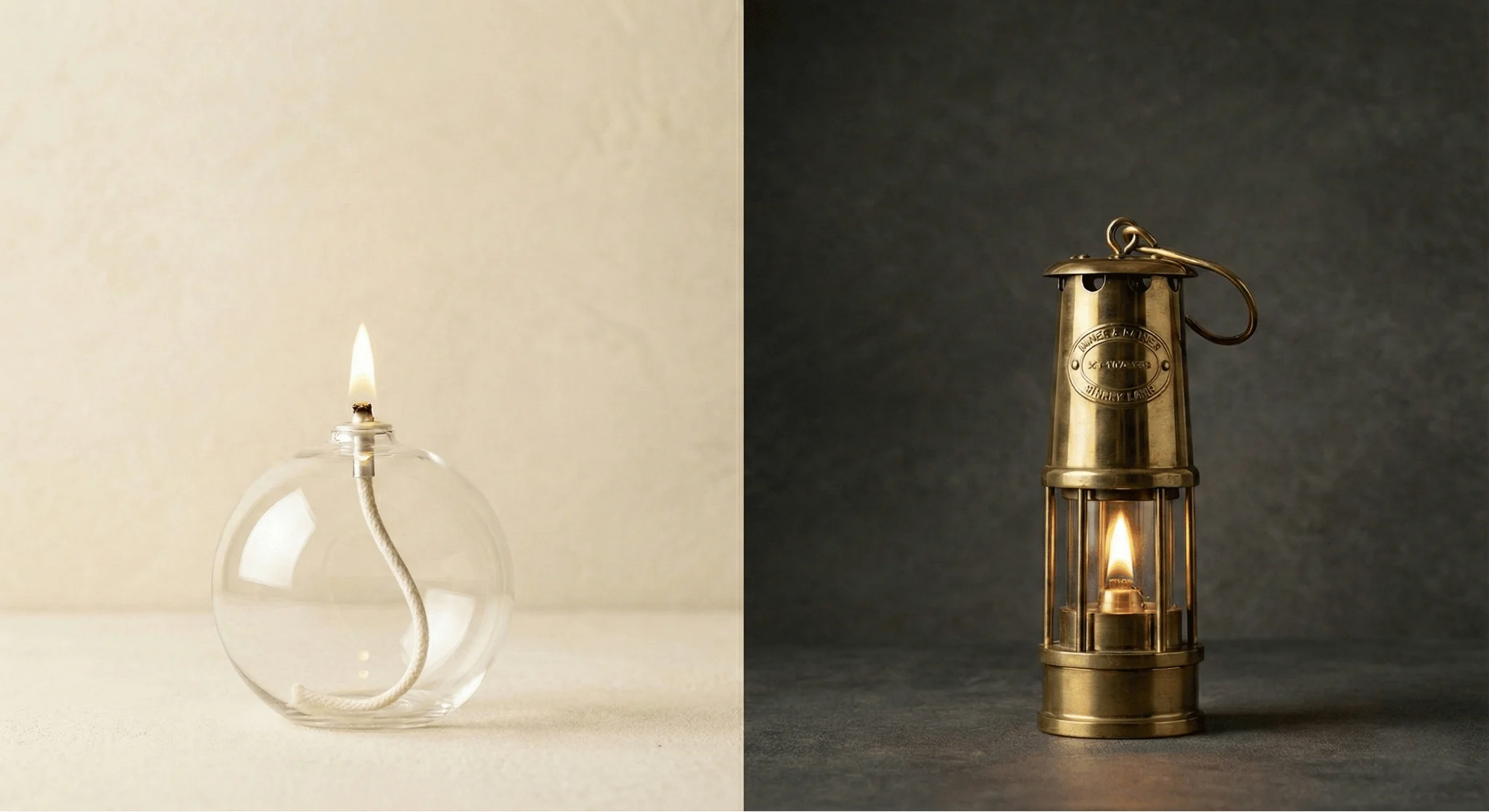
At a glance: Oil lamp vs kerosene lamp
Fuel: The traditional oil lamp burns vegetable oils (viscous), while the kerosene lamp uses lamp oil or kerosene (fluid).
Modern Usage: Today, “oil lamps” actually run on liquid paraffin (odorless), ideal for interior decoration. The kerosene lamp remains favored for powerful supplementary lighting or outdoor use.
Performance: The kerosene lamp shines much brighter thanks to its glass chimney which draws the flame, whereas the oil lamp offers a soft ambient glow.
The Origin of the Oil Lamp
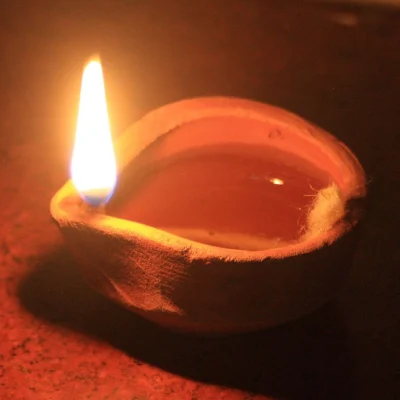
Long before electricity, humanity sought to tame the darkness. Historically, the oil lamp appeared first, its origins dating back to prehistory. Simple and ingenious, it initially functioned with tallow or vegetable oils (olive, rapeseed): a wick soaking in a reservoir absorbed the fuel by capillarity to feed a gentle flame.
The Origin of the Kerosene Lamp
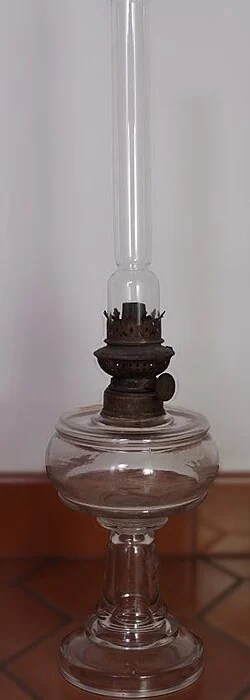
As for the kerosene lamp, its advent dates to 1853, invented by the pharmacist Ignacy Łukasiewicz. It was a true industrial revolution, offering for the first time a powerful and stable light thanks to a more fluid fuel and a glass chimney optimizing the draft.
Despite its efficiency which illuminated the 19th century, it had its flaws: a strong characteristic smell of petroleum and glass (the chimney) that blackened quickly if the wick was poorly adjusted.
Today: The Reinvention of Light
With the arrival of electricity, these luminaires could have disappeared. On the contrary, they have freed themselves from their purely utilitarian function to achieve the status of art objects.
The kerosene lamp has become the emblem of vintage and industrial style. With its patinated metal, brass, or colored glass finishes, it dresses up lofts and rustic-chic interiors, recalling the atmosphere of yesteryear’s workshops.
The oil lamp, meanwhile, has metamorphosed into a true modern design object. Sleek, often consisting of a simple transparent glass bubble or a minimalist pebble, it integrates perfectly into contemporary decors.
This renaissance was only possible through one innovation: the abandonment of ancient fuels in favor of liquid paraffin. This refined mineral oil, totally odorless and smokeless, has allowed the reintroduction of the naked flame into our demanding interiors without the inconveniences of the past.
How Does an Oil Lamp Work Compared to a Kerosene Lamp?
1. The Oil Lamp
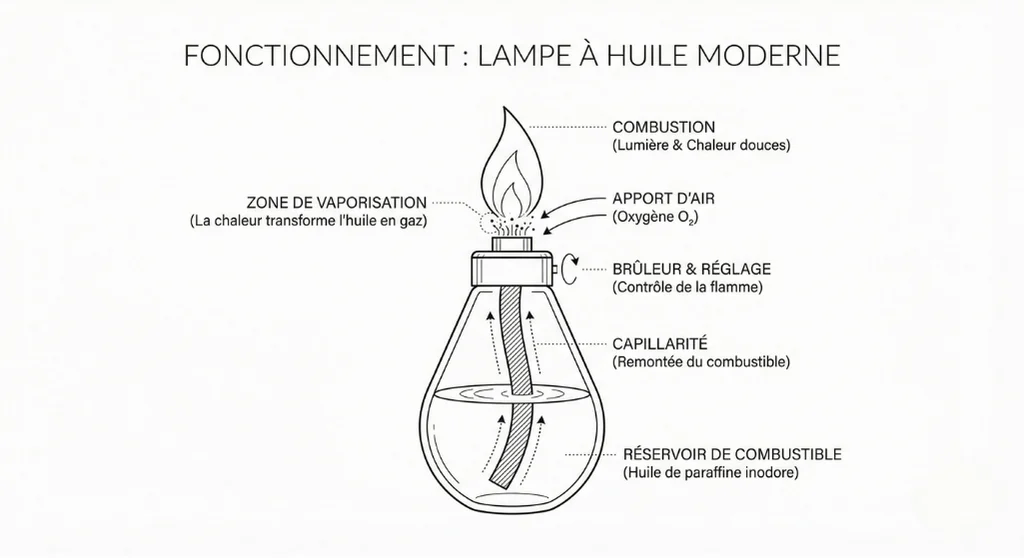
The functioning of our glass oil lamps relies on capillarity.
- The Mechanism: With liquid paraffin (very fluid), the fuel rises effortlessly along the wick to the burner. The heat then transforms this oil into gas (vaporization) which ignites upon contact with oxygen.
- Combustion: The flame generally burns in the open air. It remains soft and decorative but is sensitive to drafts because there is no glass to force the draft.
- Historical Nuance: Formerly, lamps used viscous vegetable oils (olive, rapeseed). As this thick liquid climbed poorly, the wick had to be very short and close to the oil level, otherwise, the flame would go out.
2. The Kerosene Lamp
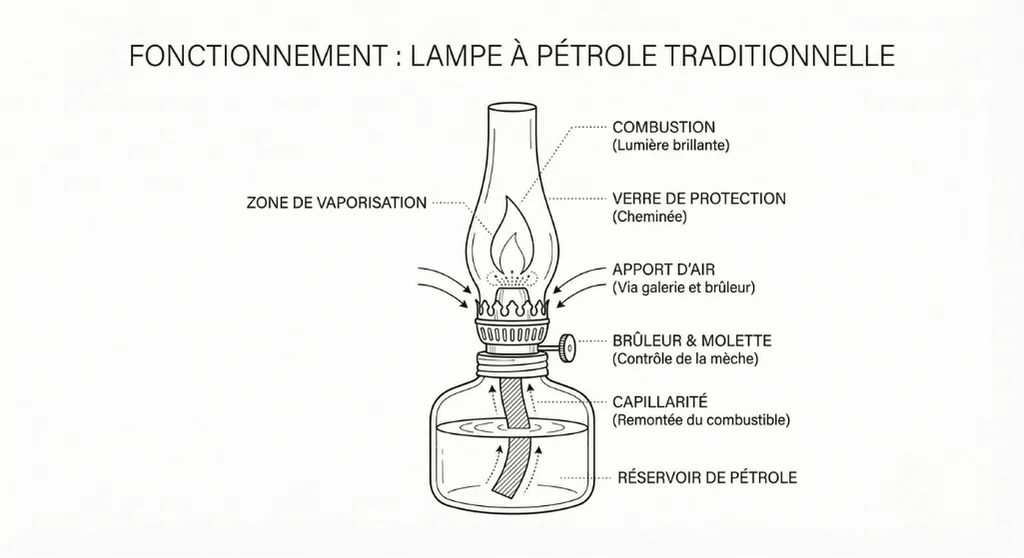
This is an industrial evolution designed to maximize light output. Lamp oil (or kerosene) is a very fluid liquid, almost like water.
- The Mechanism: Thanks to its high fluidity, kerosene rises very easily by capillarity along a long braided wick. This allows for a deep reservoir located much lower than the flame.
- The Role of the Chimney: This is the big technical difference. The glass (the chimney) placed on the burner creates a draft (chimney effect). This influx of oxygen boosts combustion: the flame becomes whiter, brighter, and does not smoke.
Which Fuel to Choose for Your Lamp?
This is the most frequent question and the most common mistake.
- For an antique kerosene lamp or a storm lantern: Use exclusively dearomatized petroleum. Never use gasoline (risk of explosion) or rubbing alcohol.
- For a modern oil lamp (glass pebble type): Prefer colorless and odorless lamp paraffin oil. It is a highly refined petroleum derivative that does not smoke indoors. You can use vegetable oils only if the lamp is specifically designed for it (floating wick), otherwise, the wick will clog quickly.
Comparison: Oil Lamp vs. Kerosene Lamp
| Criteria | Oil Lamp | Kerosene Lamp |
|---|---|---|
| Main Fuel | Vegetable oils (e.g., olive/rapeseed) or Paraffin oil. | Kerosene (lamp oil), hydrocarbon mixture. |
| Smell | Odorless or pleasant (with vegetable oils). | Often “pungent/chemical” smell, especially at lighting. |
| Smoke / Combustion | None if adjusted correctly. | “Relatively clean” and bright if used correctly. |
| Burn Time | 200h/L of paraffin. Wick does not wear out. | 20h to 50h per liter. |
| Fire Risk | Lower risk (less volatile fuels). | Significant risk if spilled; requires maintenance. |
| History | Used since before Antiquity. | Developed in 1853 (Industrial Revolution). |
Budget: Purchase and Usage Cost
The price differs depending on whether you are looking for a decorative object or a collector’s piece.
Fuel Cost: Paraffin oil is more expensive per liter (€6 to €12) but very economical to use thanks to slow combustion. Conversely, dearomatized petroleum is cheaper (€3 to €6/L) but a powerful kerosene lamp will consume its reservoir much faster.
Lamp Price: The modern oil lamp is the most accessible, generally between €15 and €50. The kerosene lamp requires a higher budget: count €30 to €50 for a new storm lantern, and up to over €300 for a restored antique.
Frequently Asked Questions
Yes, you can use liquid paraffin oil, which is the ideal modern and odorless alternative for indoors. However, never use vegetable oil (like olive or cooking oil): too thick, it will not rise up the wick and will end up burning it.
Check if the lamp has an adjustment wheel. If you see a small wheel to raise the wick and a glass chimney to force air, it is a kerosene lamp. If the system is simple, with a fixed wick placed on the reservoir without a mechanism, it is an oil lamp.
The kerosene lamp is significantly more powerful thanks to its glass chimney which creates a draft and whitens the flame. The modern oil lamp is designed to produce a soft and warm ambient light, comparable to a large candle.
No, gasoline is a fuel far too volatile and explosive for this type of burner. Use only lamp oil or paraffin oil to avoid any serious risk of fire or explosion.
Sources:
- Wikipedia – Oil Lamp: Historical evolution and vegetable fuels.
- Wikipedia – Kerosene Lamp: Technical operation and invention by I. Łukasiewicz.
- Louvre Museum – Oil Lamp Collections: Visual archives of antique models.