
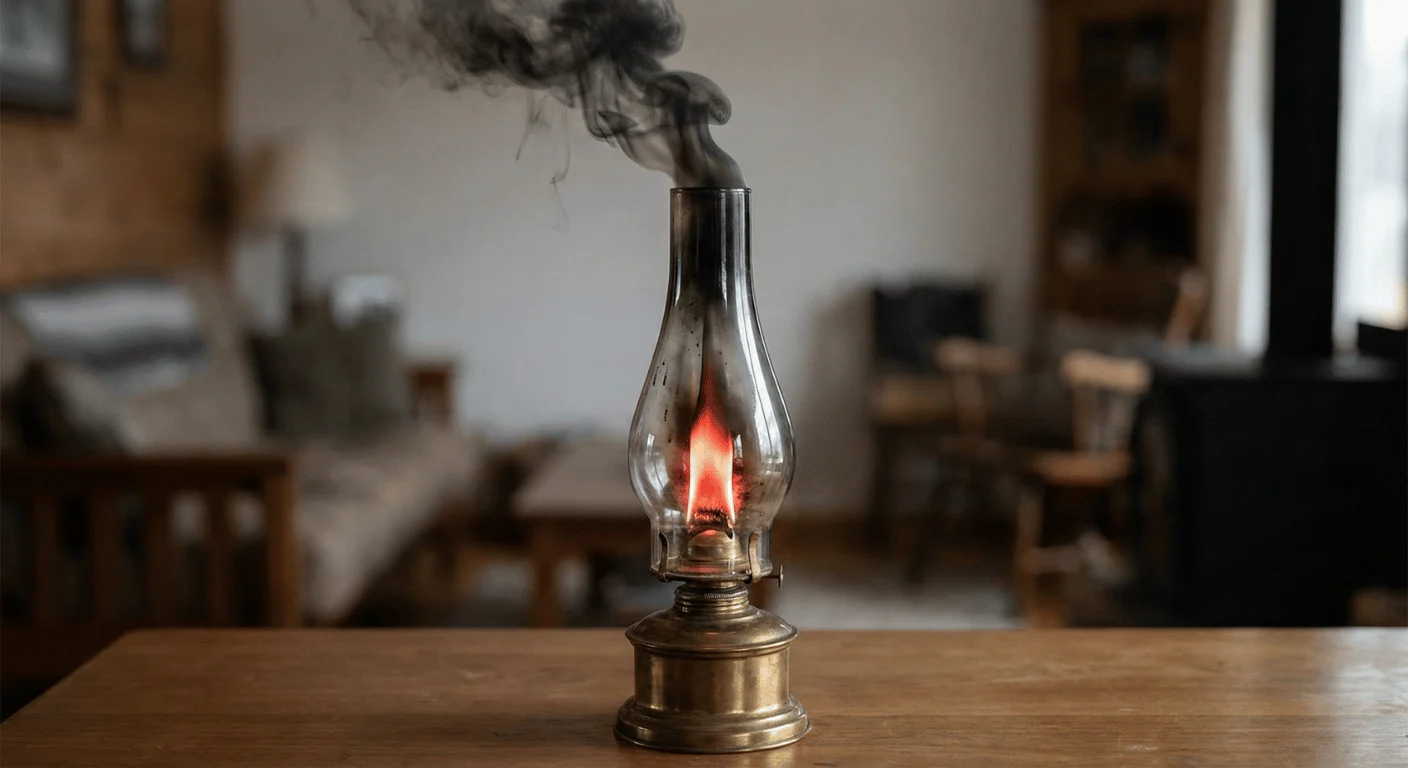
In short: Why does my oil lamp/candle smoke black?
- Wick length : The #1 cause. A wick that’s too long creates an oversized flame that can’t burn all the fuel
- Fuel quality : Impure oil or wax loaded with additives creates soot
- Drafts : Air currents disrupt combustion and cause black wisps
- Oxygen supply : A glass that’s too narrow or a dirty chimney can choke the flame
Nothing ruins a cozy, dim atmosphere faster than a flame that suddenly starts spitting out acrid black smoke. Not only does it cloud your lamp’s glass, it can also leave stubborn marks on walls and ceilings.
This issue is almost always a sign of incomplete combustion. Put simply: the flame is getting too much fuel compared to the oxygen available to burn it. The good news is that it’s usually easy to fix. Here are the most common causes and practical solutions to get a clean, clear light again.
Problem 1: The wick is too long
This is the most frequent reason. A wick set too high draws up more oil (or melted wax) than the flame can consume. The excess gets released as unburned carbon aka black smoke.
Solution
Trim your wick before every use. For an oil lamp or candle, the ideal wick height is about 5 mm to 7 mm. If smoke appears while it’s burning, extinguish the flame, let everything cool, then trim off the charred part (the little “mushroom” at the tip).
Problem 2: The fuel is low quality
Not all oils and waxes are created equal. Budget products often contain impurities, solvents, or synthetic fragrances that don’t burn cleanly. Those residues turn into soot, even if your wick is correctly set.
Solution
Always choose pure fuels. For oil lamps, the best option is a pure paraffin Oil for Lamp. Unlike common vegetable oils that can clog the burner, liquid paraffin provides a clean, odor-free burn.
Problem 3: The lamp is exposed to drafts
A flame that dances too much will smoke. Drafts push the flame around, which disrupts its steady oxygen supply. Combustion becomes uneven, and black wisps escape intermittently.
Solution
Watch your flame. If it’s flickering frantically, move your lamp/candle away from open windows, fans, or high-traffic areas. A steady flame is a clean flame.
Problem 4: The wick is unsuitable or worn out
Wick material matters for capillary action (how well it pulls oil upward). Low-quality cottonor a poorly designed synthetic wick can char excessively.
Solution
Check your wick’s condition. If it’s too old or gunked up, replace it. For maximum durability and optimal capillary action, we recommend our fiberglass wick for oil lamps:
Unlike cotton, which burns away quickly, fiberglass doesn’t burn; it simply carries the oil, which significantly reduces the risk of smoke.